Market · 13 min read
Why Brazil Is the Best Market in the World to Build an Onchain Neobank
Most people are still looking for the next great neobank market in the wrong places.
They look at the United States because of capital. They look at Europe because of financial sophistication. They look at Singapore or the Gulf because of regulatory ambition. But if the question is not where to build another fintech app, and instead where to build the most important onchain neobanks of the next decade, then Brazil deserves to be at the center of that conversation.
In fact, Brazil may be the single best market in the world for it.
Not because it is the richest market. Not because it is the easiest one. But because it combines four conditions that rarely exist together in the same country: a young and digitally native population, one of the most successful instant payment systems ever built, a still-underpenetrated investment culture with strong financial aspiration, and a geopolitical position that gives it relevance without placing it near the world’s main conflict theaters. Brazil’s average age reached 35.5 in 2023, Pix became the most-used payment method in the country with 76.4% adoption, Brazil assumed the BRICS presidency in 2025, and the EU-Mercosur partnership reached a political agreement.
That combination matters because the best market for onchain neobanks is not simply the market with the most money today. It is the market where users are already digital, where local infrastructure has removed behavioral friction, where people still feel that access and opportunity are unevenly distributed, and where consumers, companies, and wealthy families are increasingly forced to think across currencies, borders, and jurisdictions. Brazil fits that profile unusually well. Capital-markets issuance in the country hit a record R$838.8 billion in 2025.
This is why the opportunity in Brazil is not just “crypto banking.” It is much bigger than that. The real opportunity is to build neobanks that use onchain rails to solve three different but related demands: the consumer desire for asymmetry and cheaper dollar access, the high-net-worth desire for protection and control, and the business demand for an actually modern financial operating system.
Consumer Neobanks: the bank of asymmetry
The winning consumer neobank in Brazil will win because it offers something powerful: access to asymmetry.
That word matters in Brazil. This is a country with a young, highly digital population that is still early in its wealth-building journey, but already deeply comfortable with mobile-first financial behavior. Users are not only looking for efficiency. They are looking for upside, access, and the possibility of moving financially faster than the traditional system would normally allow. In a market like that, the appeal of a financial product is not just safety or convenience. It is opportunity.
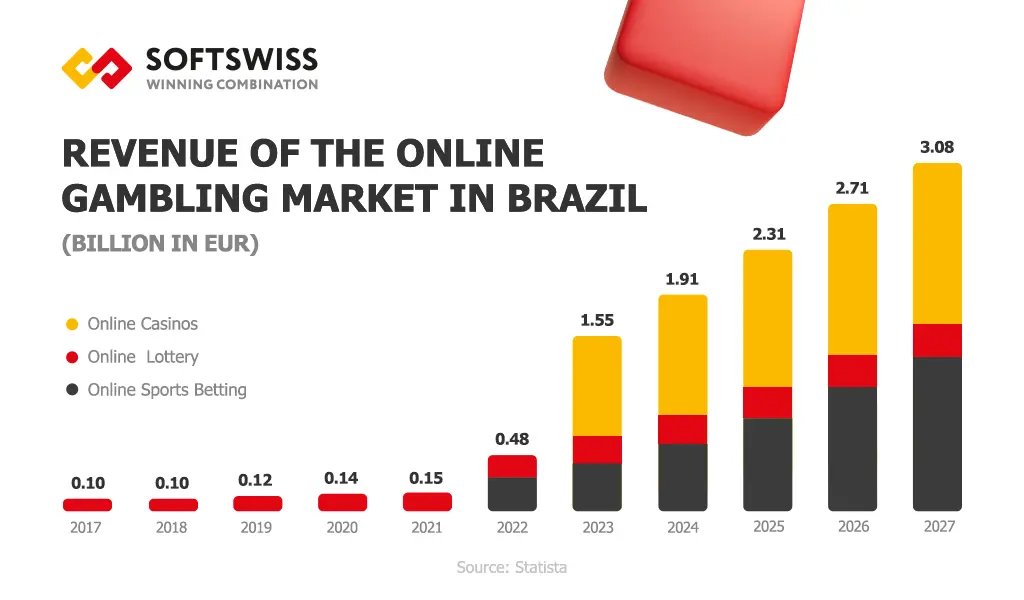
That helps explain why speculative behavior has become such a visible part of the country’s financial culture. Betting is no longer a side phenomenon in Brazil. Reuters reported in April 2025 that Brazilians were wagering as much as R$30 billion per month on online betting. That does not mean banking should become gambling. But it does reveal something important about user psychology in Brazil: for a huge number of people, the attraction is not centered on slow optimization. It is centered on the possibility of a leap. The perceived opportunity often matters more than the perceived risk.
That is why the most interesting consumer neobanks in Brazil may not be the ones that simply digitize retail banking (Nubank, Inter and C6 already did that). They may be the ones that turn the bank account into a gateway to things that feel meaningfully more powerful than a normal bank menu: global investing, yield-bearing balances, tokenized assets, onchain dollar exposure, and products that introduce a more participatory and high-engagement relationship with finance.
This is also why I am especially curious about how prediction markets and prize-linked financial products (such as the OG @PoolTogether_) may perform in Brazil. Brazil already has the behavioral ingredients for them: digital-native users, strong speculative appetite, and a culture that responds to products offering asymmetrical upside. That is no longer a purely theoretical idea. In March 2026, Kalshi chose Brazil for its first international expansion through a partnership with XP.
That does not mean every prediction-market product will work, or that prize-linked products in the spirit of PoolTogether will instantly gain mass adoption. But Brazil is one of the few markets where it is easy to imagine those formats finding real traction, precisely because users are already culturally comfortable with digital financial participation that feels interactive, high-conviction, and potentially high-upside. In a market like this, the boundary between banking, investing, gaming, and speculation may become more fluid than many incumbents expect.
There is also a second, much more practical reason consumer onchain neobanks are gaining traction in Brazil: they give users a cheaper and smoother way to interact with the dollar.
That is the hidden wedge behind products like KAST, RedotPay, and ether.fi Cash. KAST has built Pix-based funding and spending flows for Brazil. RedotPay launched crypto-to-bank-account payouts into Brazilian accounts. ether.fi Cash added Pix complete transfers in BRL on top of its crypto-backed card and cash-management experience. Even without needing perfect internal numbers from each company, the pattern is obvious: Brazil is one of the first markets these products keep localizing for because the use case is unusually strong.
Why is that use case so strong? Because in Brazil, interacting with the dollar through traditional rails is still expensive. Since the 2025 IOF changes, many outbound foreign-exchange transactions and international card-related flows have been standardized around a 3.5% IOF Tax burden, before counting issuer and FX spreads on top. Alongside IOF, taxes for these operations can go up to 13%. So when a Brazilian user can travel, pay for AI subscriptions, run global ad spend, receive money from abroad, or spend internationally through crypto-native or foreign-card rails with less friction, that is not just a cool crypto experience. It is a direct economic improvement.
This is the deeper reason Brazil is becoming such fertile ground for consumer onchain neobanks. The country already has digital habits, already understands instant money movement, and already has huge demand for better access to global finance. A consumer neobank does not need to teach Brazilians to trust digital money. Pix already did that. It only needs to show them that their financial life can be more global, more flexible, and more asymmetrical than the local banking system ever allowed.
Some Brazilian Native players building Consumer Neobanks:
@neobankless, @chainlesscripto, @usePicnic, @usebipa
HNWI Neobanks: private banking for a world of sovereign uncertainty
If consumer neobanks in Brazil will win through asymmetry, HNWI neobanks will win through something else: treatment, control, and protection.
The affluent Brazilian client is not just looking for returns. They are looking for better service, faster support, stronger alignment, more diversified custody, and a more intelligent balance-sheet architecture. A meaningful part of this audience is politically and institutionally skeptical. They live in Brazil, spend in Brazil, and often make their money in Brazil, but they do not want their entire wealth exposed to a single banking system, a single currency, or a single jurisdiction.
That is the real opening for onchain HNWI neobanks. Not anti-Brazil, but post-naive. Not “escaping the country,” but refusing to keep an entire balance sheet trapped inside one domestic stack.
This matters even more because wealthy clients in Brazil still want BRL exposure and still want local yield. Brazil remains a high-rate economy: in March 2026, Copom cut the Selic to 14.75%. So affluent Brazilians do not want to abandon local opportunities. They want something subtler and smarter: the ability to keep benefiting from Brazilian rates and local liquidity while also moving part of their wealth into assets, custody models, and rails that are less dependent on the traditional banking system.
That makes the winning HNWI neobank in Brazil look much closer to a rebuilt private bank than to a fintech app. It needs white-glove onboarding, concierge-style responsiveness, strong human support, global asset access, onchain BRL balances, Selic-linked products in programmable form, and stablecoin or dollar liquidity that can sit outside the old domestic structure. The product is not just a portfolio. It is a new jurisdictional architecture for wealth.
And it will be competing directly against the biggest names in Brazilian wealth management: Itaú Private, BTG, Safra, and especially XP. XP matters most because it proved how powerful the advisor model could be in Brazil. In 2025, XP reported about R$1.491 trillion in client assets and 18,000+ advisors. That scale alone shows how deeply the firm reshaped wealth distribution in the country.
But the next cycle may not belong to the same model. The collapse of Banco Master intensified scrutiny around how higher-yield products were distributed through large investment platforms. Bloomberg reported that XP had sold more Banco Master CDBs than any other institution, and the episode widened the debate over whether commission structures had distorted alignment between advisors and clients. Whether one sees that as a failure of individuals or of the model itself, the outcome is the same: trust in advisor-led distribution is no longer automatic.
That is the strategic opening for HNWI neobanks. They can position themselves not as cheaper wealth platforms, but as more aligned ones: better treatment, more transparent incentives, more direct control, stronger global diversification, and continued BRL utility without forcing the client to leave their entire financial life inside the same old structure. In a country like Brazil, where wealthy clients often want to de-risk Brazil without fully disconnecting from Brazil, that is a very powerful proposition.
Some Brazilian native players building HNWI Neobanks:
@rivool_finance, @koresolutions_, altside.com
Business Neobanks: the biggest gap in Brazilian banking
The biggest opportunity may be the one least discussed: business neobanks.
Brazil still does not have a truly great bank for modern businesses. Not a great traditional one. Not a great neobank one. And certainly not a great onchain one.
What exists instead is fragmentation. Some players are good at merchant acquiring. Some are decent at payment acceptance. Some offer business accounts, cards, payroll, or payables features. But very few actually behave like the full financial operating system a company needs. PagBank, for example, offers business accounts, payroll automation, Pix and TED transfers, and cards. That is useful. But it still reflects the gravity of a payments-and-commerce ecosystem, not a deeply integrated treasury, global-payments, credit, and operating-finance platform for a modern company.
That gap matters because the Brazilian business of today lives in two financial worlds at once.
It still has to operate locally: payroll in BRL, taxes, Pix collections, suppliers, working capital, local payables.
But it increasingly operates globally too: cloud software in dollars, AI subscriptions, international ad spend, foreign contractors, imported services, cross-border payouts, and treasury decisions that do not fit neatly inside the local banking stack.
Traditional banks do not handle this duality well. Most business fintechs do not either. They may help a company receive money, but they do not really help it operate.
And this becomes even more painful when credit enters the picture. Brazil’s official monetary and credit statistics showed that the average annual rate on free corporate credit was 24.9% in March 2026. More broadly, both World Bank work and Central Bank research have long described Brazil as an international outlier for lending spreads and the cost of financial intermediation.
This is where the business-neobank thesis becomes much stronger than “better business banking.” The opportunity is to build the first bank that actually understands the full operating reality of a Brazilian company: local rails plus global rails, payroll plus treasury, cards plus FX, receivables plus working capital, stablecoins plus BRL, and eventually credit products that are based on real business cash flows instead of old-school banking inertia.
That is also why onchain rails matter so much here. They are not just useful for consumer speculation or stablecoin savings. They are especially powerful for treasury unification: moving between BRL and dollars, holding liquidity in programmable form, paying internationally, generating yield on idle balances, and opening the door to better forms of collateralized, receivables-based, or cash-flow-based credit. In business banking, onchain infrastructure is not a gimmick. It is one of the clearest ways to reduce fragmentation. Pix already made Brazil operationally ready for real-time money movement.
This is what makes business neobanks such a large opportunity in Brazil. The market is not saturated. It is unfinished. The company that solves this category will not just build a better SME bank account. It will build the operating system for a generation of Brazilian companies that are locally incorporated but globally exposed.
Some Brazilian native players building Business Neobanks:
Why Brazil beats the alternatives
A lot of countries have digital users. A lot of countries have wealth. A lot of countries have crypto adoption. A lot of countries have real-time payments. Very few have all of those things at once, and even fewer have them in a market that still has this much room for reinvention.
Brazil does.
It has the behavior. It has the payment rails. It has the aspiration. It has the size. It has geopolitical relevance. It has a wealthy class that wants more sovereignty over its balance sheet. It has consumers who want a better way to live in dollars. And it has businesses that still do not have a truly complete financial stack. Pix made Brazil operationally digital.
That is why Brazil is not just a good market for onchain neobanks. It may be the best one.
Because the next banking winners will not be the ones that simply offer the nicest interface. They will be the ones that turn banking into something larger: a gateway to global opportunity for consumers, a more aligned wealth architecture for affluent clients, and a true operating system for businesses. Right now, few countries look more ready for that transition than Brazil.
Nora: why this thesis leads to BRL DeFi
This is the logic that led us to Nora.
The more we studied the neobank opportunity in Brazil, the clearer it became that the country does not just need better onchain neobanks. It also needs the financial rails beneath them.
If consumer neobanks want cheaper dollar access, if HNWI neobanks want BRL yield exposure with more control, and if business neobanks want better treasury and credit products, then Brazil needs deeper DeFi markets in BRL.
That starts with a strong BRL stablecoin.
Not just a tokenized real, but a real monetary base for onchain finance in Brazil, one that can support payments, savings, treasury, liquidity, and credit.
But the opportunity goes beyond the stablecoin itself. Brazil is a high real yield economy, and that changes the equation. A BRL stablecoin should not only move money. It should also connect users to compelling local yield.
That is why Nora’s thesis is not just about creating a BRL stablecoin. It is about building the onchain market around it: a BRL base asset, yield options that reflect Brazil’s rate environment, and a bridge between Brazilian RWA yield and the neobanks that can distribute those products at scale.
In that model, neobanks become the interface, BRL DeFi becomes the infrastructure, and Brazilian yield becomes the engine.
That is the market Nora is building for.
Publicado originalmente em https://x.com/cioffi_victor/article/2043792313483219052