Market · 10 min read
World’s Biggest Fintech Gap: Brazilian Credit Spread
Brazil may be home to one of the biggest fintech opportunities in the world, and the reason is hiding in plain sight: credit spread.
In July 1994, Brazil killed one of the most violent inflations in modern history. For decades, Brazilians had lived inside economic chaos. Prices doubled every month. Supermarkets updated stickers twice a day. Workers cashed paychecks and ran to spend them before lunch, because by dinner the money would be worth less. The country burned through five currencies in ten years. Economists called it "chronic inflation."
Then came the Plano Real. A new currency. A new central bank posture. A brutal, calculated reset. It worked. Inflation dropped from 2,000% to single digits. The currency stabilized. Brazil started looking like a serious economy. That was 31 years ago but the trauma never fully left the credit system.
Brazil today has no war. No hyperinflation. No currency crisis. It is the 10th largest economy on Earth, with a sophisticated banking sector, a strong agribusiness export machine, and one of the most advanced instant payment systems in the world. And yet, Brazilian borrowers still pay some of the highest credit spreads on the planet.
In one of the world’s largest economies, credit remains expensive, selective, and often irrationally distributed. Even in 2026, Brazil’s average lending rate is still around 33% per year, which stands at 26.85 percentage points, second only to Madagascar’s 35.68, and far above Mexico (4.88), Colombia (6.47), Iran (5.20), Russia (3.01), and even conflict-affected Ukraine (8.21). This is not a small inefficiency. It is a structural gap large enough to define entire business models, shape consumer behavior, and create room for a new generation of financial infrastructure.
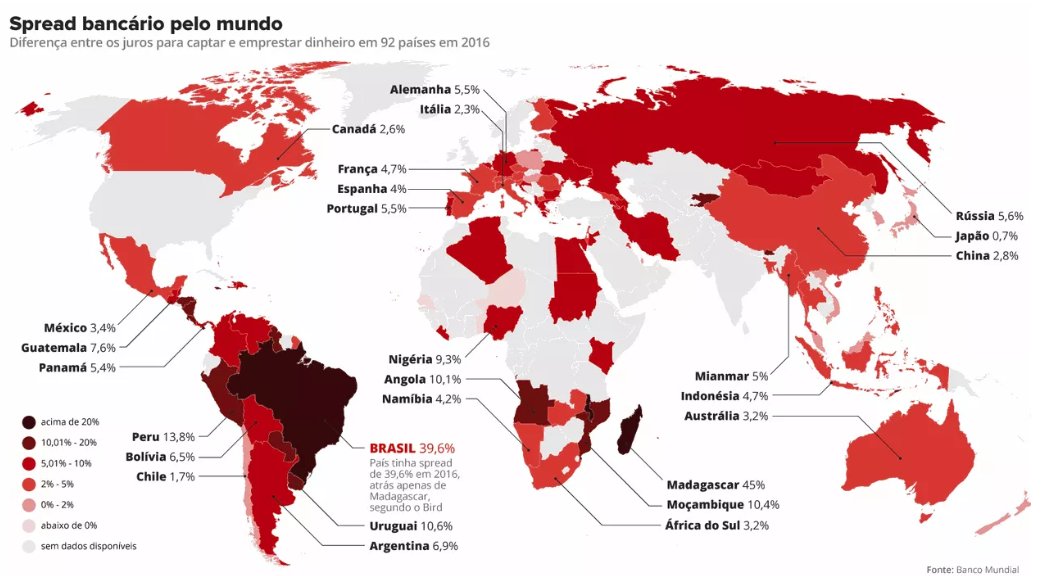
That is what makes Brazilian credit such a unique opportunity. In many markets, fintech innovation is about improving convenience. In Brazil, It can still be about improving life, reducing rates, and market design at the same time.
The roots of this gap are deeper than the common explanation of “Brazil has high interest rates.” That is true, but incomplete. Brazil’s credit market has historically been shaped by macro volatility, high base rates, low domestic savings, directed credit programs, operational overhead, weak recovery dynamics, and frictions in collateral and insolvency regimes. The World Bank has described Brazil as an international outlier in loan-to-deposit spreads, and the Central Bank’s own research shows that high funding costs, taxes, default probability, and low recovery rates explain far more of the spread than concentration alone.
In other words, this is not just a story of banks charging too much. It is a story of a system that prices uncertainty, friction, and inefficiency into every loan.
And when a financial system works like that, the result is predictable: credit becomes less about merit and more about format. Borrowers do not necessarily get capital when they are good. They get capital when they fit the underwriting model.
That is where the second part of the opportunity begins.
Because one of the least understood truths about Brazilian credit is that even borrowers with strong repayment histories, recurring revenues, real guarantees, and exposure to relatively resilient sectors still run into credit constraints. This happens all the time with niche operators, trade-focused businesses, receivables-rich companies, and disciplined borrowers whose risk profile looks much better in practice than it does inside a generic credit engine.
This is especially visible in small and medium-sized businesses. OECD work on Brazil has noted that credit conditions remain tight for SMEs, with high spreads versus larger companies, while broader SME finance research consistently shows that limited collateral, weak credit visibility, and high information asymmetry restrict access even when businesses are viable. The issue is not always willingness to pay. Very often, it is the lender’s inability to understand the asset, the flow, the niche, or the guarantee well enough to lend confidently against it.
That creates a perverse outcome: many borrowers accept bad credit terms not because the pricing makes sense, but because the availability itself becomes the product.
In healthy credit markets, competition forces lenders to offer better prices. In Brazil, that's not how it works for most borrowers. They optimize first for getting approved, then for how fast the money comes, and only last for what it actually costs.
The credit they get is often expensive, full of restrictions, or poorly matched to their cash flow. They take it anyway, because bad financing still beats no financing at all.
This is why the Brazilian credit spread is not just a banking problem. It is a distribution problem. A data problem. A collateral problem. A market design problem.
And that is exactly why it is such a major fintech opportunity.
The next frontier in Brazilian credit will not be won only by institutions with more capital. It will be won by players that know how to underwrite specific niches better, recognize non-obvious guarantees, understand the real repayment behavior of their users, and use better infrastructure to originate, fund, and distribute credit more efficiently than the traditional system allows.
So how do we fix this?
Before talking about solutions, we need to understand why the current system fails. Let's use trade finance as an example. It is one of the biggest markets on earth. And for Brazil, it is the country's greatest economic force. The world's largest exporter of soybeans, coffee, sugar, orange juice, beef, and chicken. A top five global player in iron ore, pulp, and corn. $400 billion in exports annually. The country feeds and supplies a significant share of the planet. When global supply chains need commodities, they call Brazil.
And yet: only 1% of Brazilian companies export. One percent.
In a country with millions of businesses, with ports on both oceans, with direct trade routes to China, Europe, the Middle East, and the United States, almost nobody participates in international trade. Why? 40% of Brazilian companies cannot access credit at all. And among those that can, most cannot access the specific working capital products that trade requires: tools that let a company buy inputs, produce goods, ship containers, and wait 60 or 90 days for payment. Imagine the impact on the Brazilian economy if we could improve the credit acceptance rate or the number of companies with access to working capital.
This is not a Brazilian anomaly. The global trade finance gap sits at ~$3 trillion (Source: Asian Development Bank). It represents real companies, moving real goods, getting rejected for working capital they could reasonably repay. The gap has not shrunk meaningfully in years. It persists through every fintech wave and banking innovation cycle. The thing is, banks are structurally incapable of closing this gap. Their underwriting relies on audited financials, credit bureau scores, relationships, and so on. If a borrower does not fit the template, they do not get credit. Also, the cost of underwriting a $50,000 loan is nearly the same as a $5 million one. Same KYC. Same documentation. Same compliance. But the revenue is a fraction. So banks rationally focus on larger clients and leave everyone else behind. In Brazil, most companies do not even apply. They already know the answer. This is not a criticism of banks. They are doing what their models tell them to do. The architecture itself is the constraint.
How do we close this gap?
Most lenders build horizontally. They want scale, standardization. They want borrowers who fit neatly into a model trained on other borrowers who also fit neatly into models. This works until it does not. And in Brazil, for entire categories of borrowers, it does not. The winners in the next cycle of finance will be vertical. They will pick a niche and know it cold. Not "SME lending." Something specific enough that they can see what generic models miss. Which receivables actually get paid. Which export corridors have reliable buyers. Which collateral can be moved, inspected, liquidated. Which borrowers have twenty years of clean history that never made it into a credit bureau.
But this is exactly where the opportunity comes from. The shift will happen by solving four layers:
Stablecoins solve the settlement layer. Settlement becomes a function, not a department. Tokenized collateral solves the visibility layer. The same document represented on-chain becomes an asset: verifiable, transferable, fractionable, programmable. Real-time data solves the underwriting layer. Traditional credit analysis relies on annual financials, often 12 to 18 months stale. When you can observe actual cash flow daily, when you can see invoices being paid, when you can track the velocity of receivables in real time, the underwriting model inverts. Risk becomes observable.
Programmable money solves the structural layer. Loans that self-liquidate, escrow that releases automatically when documents are verified. The operational overhead that made small facilities uneconomical disappears. None of these layers work in isolation. The opacity that made niche lending risky disappears. What remains is a structure that scales and lets you execute on it.
A new generation of players is emerging at the intersection of payments, credit, and programmable finance. Companies like Vero are building credit rails specifically designed for trade finance, using stablecoin settlement, real-time data, and tokenized collateral deployed to DeFi and institutional capital. The model is: go deep into a vertical, understand the risk better than any generic model can, and use modern infrastructure to originate, fund, and service credit at a cost structure that makes small facilities economical. For Brazilian exporters, this means access to working capital. For funds, it means access to a $3 trillion gap with historically low default rates in one of the safest asset classes in emerging markets.
Payments are essential, but they tend to become infrastructure: necessary, standardized, and increasingly commoditized. They move money, but over time they capture lower and lower margins as competition pushes fees toward zero.
The real value appears when payment flow starts carrying context. A transaction is not just money moving from one account to another. It includes counterparties, contracts, documents, obligations, timing, and performance. When that information is visible inside the system, payments stop being just settlement and start becoming underwriting signals.
That is where credit becomes possible in a different way. Instead of relying only on static financial statements, bureau data, or generic borrower categories, lenders can evaluate real business behavior and underwrite with far greater precision. This creates a compounding effect. The more relevant financial activity a business generates, the more accurately a lender can understand risk. The better it understands risk, the more precisely it can extend credit based on its own yield target. And the more credit it enables, the more activity flows back into the system.
Brazil's credit spread will not collapse overnight. But it can compress. Every time someone figures out how to underwrite a vertical better than the generic system, a piece of that spread moves. In 1994, Brazil proved it could reset a broken monetary system when someone decided the old architecture was no longer acceptable. The credit system never got that reset. The tools to change that finally exist, and the players willing to do the work are already moving. The gap between Brazilian borrowers and fair pricing will not disappear in one move. But it will compress.
If Brazil's credit system is going to get its reset, it won't come from one company or one breakthrough. It will come from operators who pick a vertical, understand it better than the legacy system can, and rebuild the infrastructure underneath.
That's what we're doing.
This piece was co-written by Victor Cioffi (CBO at Nora) and Marcos Do Canto (CEO at Vero), two projects attacking the same problem from complementary angles.
Nora is building the onchain BRL layer: programmable local currency and settlement rails designed for a credit market that finally works in Brazil's favor.
Vero is building the credit infrastructure for Brazilian trade finance: stablecoin settlement, real-time data, and tokenized receivables turning one of the world's safest asset classes into something fundable at scale.
Two pieces of the same thesis.
Follow Nora and Vero to watch the spread compress in real time. The work is just starting.
Publicado originalmente em https://x.com/cioffi_victor/article/2055319598229041652